

Dr. Adam Nixon's Talk at the Society for Cinema and Media Studies
March 31, 2026
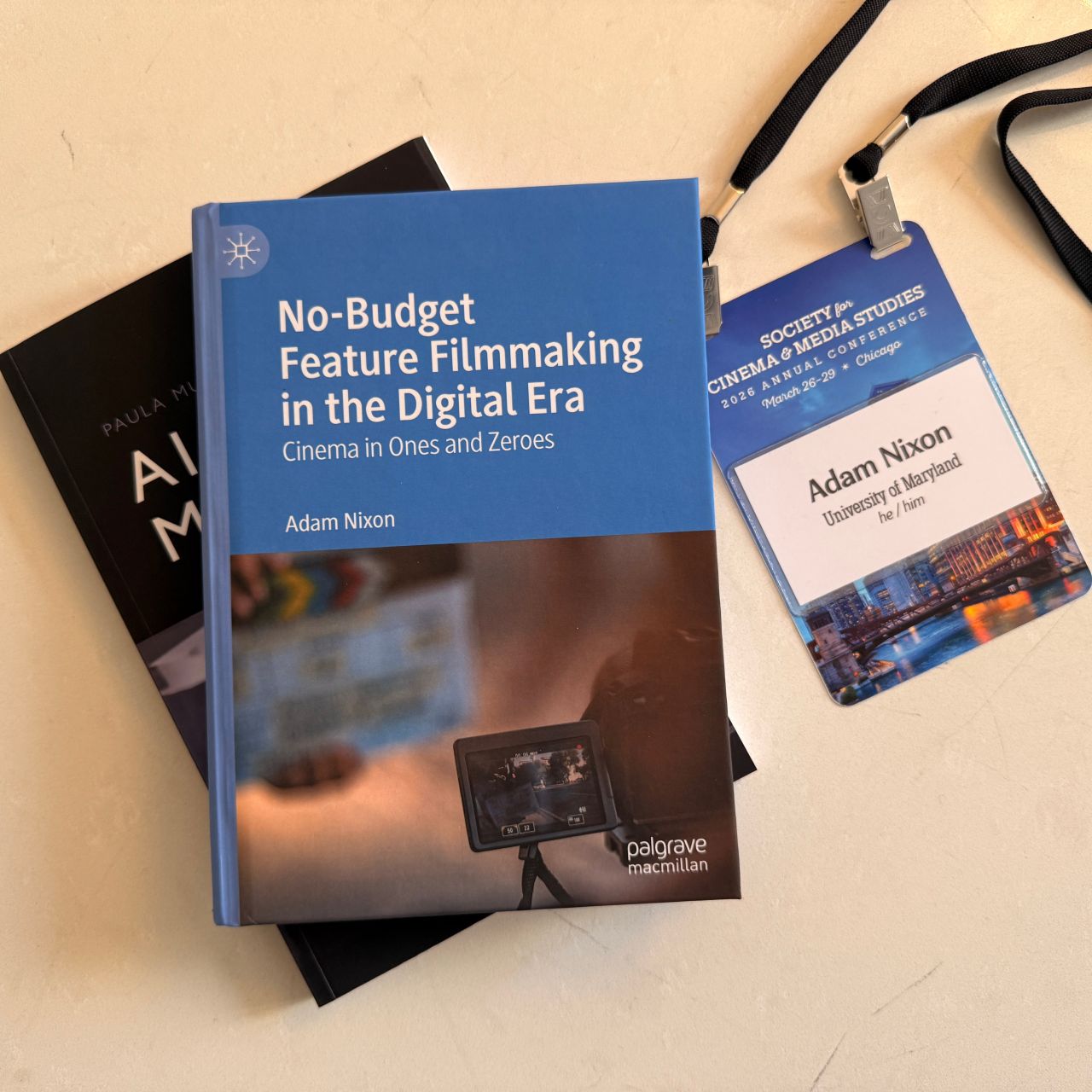
Dr. Nixon gave an engaging lecture in Chicago last week!
Senior Lecturer Dr. Adam Nixon gave a talk at the Society for Cinema and Media Studies (SCMS) conference in Chicago about the next iteration in camera sensor technology. He suggested in his essay/book chapter that newly theorized QIS sensors (Quanta Image Sensors) able to capture individual photons of light will lead to more surveillance, more advanced weapons, annoying fines, and an archiving of public spaces in a manner that can be traversed as a recreated data cube in four dimensions. All of this leading to outcomes from the horrific to the sublime.
The description of his talk is as follows, "QIS imaging technology sits at the intersection of filmmaking, computer engineering, surveillance capitalism, and political power. This talk explored what that technology might mean. A QIS sensor has at least one-billion circuits, and in the future may hold one-trillion, creating an image field one-million pixels across and one-million pixels down.
The idea behind a quantum image sensor is deceptively simple: build a camera capable of detecting individual photons reliably, pixel by pixel with an image circuit the size of a single micron (if not smaller) one-millionth of a meter. The camera is largely theoretical now, but given Moore's Law, it seems reasonable to conjecture that a future device will have these properties. At current circuit size that is a 2-meter by 2-meter chip.
Imagine that sensor with one-trillion pixels, 1,000,000 across and 1,000,000 pixels down. Now imagine recording that information, one million times per second creating a massive three-dimensional data cube traversing space and time. Furthermore, when that happens, the camera stops being just a recording device. It becomes a total capture system enabling massive surveillance architectures. With enough computational power, storage space, electricity, and capital, artists, technicians, authorities, founders, and politicians could endlessly reconstruct, manipulate, or explore this data after the fact.
Now consider the implications of such a device. Imagine recording an event so precisely that viewers could later navigate through it spatially and temporally. You could stand beside a historical figure in a recreated space. You could move through a moment in time.
Of course, that level of reconstruction is still speculative. However, the trajectory of sensor technology suggests that something close to it may eventually become possible.
You could recreate an event across time, building a true metaverse that could be traversed willy-nilly by curious viewers, by overreaching authorities, by AI looking to levy fines for myriad, often minor, indiscretions. The most likely dystopia, admittedly more annoying than terrifying, is Skynet Capital. You’ll remember Skynet Capital’s evil twin from the Terminator movies. Skynet Capital is a startup with AI run amok in your bank account. They have your credit card information, an amazing image cube, and massive memory farms to explore at will."
Congrats on an engaging lecture, Dr. Nixon!